Sunday, May 27, 2012

A Twist on an Old Cliche': Like Son, Like Father

                        It was in the heart of the Ozarks that my wife Martha and I made the most important decision of our lives. We chose to have children! At the time there was no way to truly grasp how this decision would profoundly shape the direction of our lives. Early on, however, it became very evident that parenting is not a simple transfer of knowledge and awareness from parent to child. Rather, it is a mutual exchange of experiences that shapes all of us forever. Clearly, our children unknowingly transformed us in countless and irreversible ways.   Both of them, Nathan and Laura, throughout childhood and into adulthood, instill in me a sense of wonder.  They both are environmental educators today, and continue to teach me their own lessons about the outdoors.  In the coming weeks, I've decided to write about both of them.

            This is the story of raising a birder, my son, and how birds became a part of our entire family’s life.  This was not because we necessarily wanted to learn about birds, but rather because of our then pre-school son Nathan’s fascination with feathered creatures.  Through his formative years, birding dominated his thoughts and impacted the rest of our family.  Our vacations centered around birding hotspots, as we would often combine birds, beaches, and interesting cities to make sure fun was had by all. 

            It is my observation that the best birders have an inborn, natural ability that the rest of us do not possess.  I personally was not born a birder.  I started at age 39 because my 12 year old son wanted to bird.   I still work very hard to differentiate species by song, field marks, habitats, and behavior.  Every spring I have to relearn much of what I previously thought I had committed to memory.  Once I was a general lover of the outdoors, fascinated by the beauty and complexity of all of nature.    Now I am an avid birder, but I am still fascinated by the beauty of all things natural.

            However, my son Nathan, now 32, was born a birder.  His earliest drawings were of birds and their cousins, the dinosaurs.  A precocious reader, he journeyed to the library weekly to amass a pile of dinosaur, bird, and nature-related books.   One of his favorites was Mr. Popper’s Penguins.  I remember laughing hysterically at the adventure of penguins held captive in a refrigerator.  In the 5th grade, he won an author’s contest when he wrote a book about a family of penguins that were caught on a shrinking iceberg as it floated with its flightless inhabitants along the Humboldt current from Antarctica, up the coast of South America, and on to the Galapagos Islands. 
            I wasn’t surprised when Nathan began his bird life list at the age of 12.  He didn’t begin his list in our home state of Missouri, but his interest was piqued during a spring break visit with his winter Texan grandparents in the Lower Rio Grande Valley.
 Nathan at Santa Ana NWR in the Lower Rio Grande Valley, 1992
The Green Jays, Plain Chachalacas, and Altimira Orioles in the trailer loop at Bentsen-Rio Grande State Park provided the magic spark that turned his literary interest into a full-fledged passion to seek out and discover new birds in the field.  I became his driver, and his passion for birds lured me willingly into the field as often as possible.
            It was the summer of the same year that he was introduced in summer school to Rebecca Matthews, long time birder, Audubon Society of Missouri officer,  and a founding member of the Greater OzarksAudubon Society.  That fall we joined GOAS, and participated in our first ever Christmas Bird Count in Greene County.  We were so excited to be part of the Fellows Lake team of experienced birders!  Only a week later, we were participating on a CBC team in Taney County, led by Rebecca Matthews.  Nathan spotted and identified a Palm Warbler, which became his first independent documentation write-up.  The sighting was accepted by the Missouri Bird Records Committee. 
Christian County Headliner, June 1, 1994
            In the spring of 1994, the internet became a nationwide sensation.  Both Nathan and I were contributing to the new Birdchat listserv, and our collective knowledge of birds was rapidly expanding.  It was during this time that we met two people who impacted Nathan’s birding future dramatically.  Mark Goodman and Susan Hazelwood, both officers in the Audubon Society of Missouri, notified us via email that the young person selected to receive an American Birding Association scholarship to Victor Emanuel Nature Tour’s Camp Chiricahua was unable to attend.  Would Nathan like to apply? 
  Nathan Swick (in the center) at VENT Camp Chiricahua, 1994
            The rest is history.  The birding community of Missouri rose to the occasion and with a $500 scholarship from the American Birding Association, $250 from Audubon Society of Missouri, and $250 from Greater Ozarks Audubon Society,  Nathan headed to SE Arizona to participate in the VENT Camp Chiricahua for youth birders.  It was a joint ABA, ASM, and GOAS investment in the future that paid off for both Nathan and the birding community as a whole, but not until after his ten year hiatus from birding. 
Fidra Island, North Berwickshire, Scotland

            In the summer of 1995 we took a family trip to Great Britain where we birded our way across Scotland; visiting birding hotspots;  Bass Rock, Fidra Island, St. Abb’s Head, and the Isle of Skye.   Soon after this trip, the demands of an active high school and college life placed birding on Nathan’s back burner for a decade.   It was during his honeymoon in Asheville, NC, in 2005, that the sighting of a Black-throated Blue Warbler at close range reignited the flame that he had felt as a youth, and he hasn’t looked back since.  His life in North Carolina has been bird-filled.

Birding in Costa Rica with my son Nathan, 2007

            In 2007, Nathan began The Drinking Bird blog which quickly placed him in contact with the nation’s best birders, and established him as a valuable contributor to the bird blogging world.  It was not long after that he became the southeastern U.S. birding representative for the most popular bird blog in the world, 10,000 birds.  He currently serves as coordinator of the American Birding Association Blog .  In addition, he is the eBird Reviewer for North Carolina, is active in the ChapelHill Bird Club, and works to develop future ornithological leaders by co-sponsoring the Young Naturalist’s Club of the Wake County Audubon Society.  He is truly one of a growing group of outstanding young birders who have developed their skills both in the field directly and online.  The merger of technology and direct field work is their domain, and they are taking the birding world in new and exciting directions.

            And then there’s me, the driver and the fortunate dad of the young birder.  I am a birder today because I parented a natural born birder.  Furthermore, I work with youth in the Green Leadership Academy for Diverse Ecosystems (GLADE)project, which I co-founded and currently co-direct.  The project is likely an extension of the interest in birds that developed within me when I took to the field with my young birding son.  At least, I have to give him partial credit for the bird focus in this conservation leadership development project.  The overall mission of the Green Leadership Academy for Diverse Ecosystems (GLADE) is to care for Ozarks ecosystems, to develop future community leaders, and to improve the quality of life through conservation and educational efforts throughout the Ozarks.  Specifically, our GLADE youth restore giant cane habitat in hopes that the Swainson’s Warbler will return to a small portion of the White River watershed.   It is very appropriate that the same Audubon Society of Missouri that encouraged Nathan as a teen, supports GLADE’s work to restore critical habitat for Missouri’s endangered species and to develop leaders that will positively impact the future of ornithology and avian conservation.  But then, that’s what ASM has always done.  It is this long term work of advocacy and action that gives ASM, ABA, and GOAS a special place in our family’s heart.  They helped to raise our son, and led him in the direction of his dreams. 
            The moral of the story is this.  A seemingly random act of kindness, as taken in the mid 1990’s by ASM leaders Mark Goodman, Susan Hazelwood, and Rebecca Matthews, aimed at a young birder and accompanied by a genuine concern for the birds themselves, rippled outward, resulting in new and progressive leadership within the bird conservation community.   Just like then, our investment today in youth birding and conservation can truly make a positive impact.            Will our children and grandchildren continue the enduring legacy that Missouri birders have created  and thereby experience the joyful song of the Swainson’s Warbler along a clear Missouri Ozarks stream?  As always, it’s up to us.  The answer lies within the motto of the Audubon TogetherGreen program:  Our actions today shape tomorrow.

Monday, May 21, 2012

When the student is ready.....

           His song rang out like a cathedral bell at dawn.  A rush of adrenaline increased our momentum as we descended toward the spring branch.  Again, his alluring melody arose from this lush cane sanctuary.  We stopped to capture this moment, to feel the intensity of this melody.  This bird was no ordinary bird, and this quest was no ordinary quest.   
            This quest required many years of searching, and this bird impacted my life’s journey, even before I knew it existed.   When I became aware of its existence and searched repeatedly for it, it eluded me.  Somehow I sat back on my laurels, believing that I could encounter this species like the first robin of spring.  By the time I realized that this would not be the case, the years had passed and the miles of driving cross country and hiking through dense cane labyrinths had accumulated.  I recognized that I would come to this bird only when the species, and I, were ready.  “When the student is ready, the teacher will appear,” I recalled in some lost bit of literature.  
            I was joined this day by my friend and colleague Andrew Kinslow.  We had time to prepare, as several reports from the area confirmed the bird’s presence, but none of the seekers before us came away with more than a fleeting glance of this “King of Camouflage”, the Swainson’s Warbler.  Learning from those who had gone before us, we quickly quelled our desire to rely upon digital playback.  On this day, by broadening our perspective and fully understanding the nature of this encounter, we developed a more appropriate strategy. 
            With my lawn chair and Andrew’s camping stool, my journal and his book, my river shoes and his bare feet, and our cameras and binoculars in hand, we traversed the bubbling stream, and listened for the effervescent warbler song rising above the stream’s din.  We approached the repetitive melody, settling into a marginal clearing within the dense Giant Cane that towered 18-20 feet above us.  We were determined to stay as long as necessary for the bird to welcome us into its lair.
            Birder Matt Andrews soon arrived (I knew him from previous shared viewings of shorebirds, and most recently, a California Gull he discovered in the Ozarks last fall).  We first saw Matt following the bird’s call from tree to tree.  When the warbler returned to our location at the center of canebrake, Matt approached us, and we invited him to join us.  It was a winning combination!
            The warbler flew from perch to perch without giving even a slight clue.  We were amazed at his uncanny ability to fly undetected over and over again.  However, within 15 minutes, Matt exclaimed in a near whisper, “I got him”.  He patiently lowered his binoculars to give us visual clues to the bird’s location on a bare limb 30 feet above the ground, just above the canopy of the canebrake.  Its long, pointed bill stood out as its most obvious field mark, but we basked in our view of its chestnut cap, it light supercilium, and dark eyeline.  All three of us watched in awe as the bird sat in an unobstructed clearing, singing every 10-12 seconds during one of those “eternity in a moment” experiences.  In reality, probably 2-3 minutes elapsed before the bird moved on, continuing its circuitous route.   
            This warbler broke all of our stereotypes for the cryptic skulker.  It was amazingly cooperative, and truly did not appear to care that we were there to observe its daily activity.  This experience gives me an opportunity to say a word or two about the birding world’s current obsession with playback devices.  First, I am not opposed to the proper and ethical use of such devices.  In fact, I use mine frequently.  But, I think it’s important to note that we should do our best to understand each individual species before, and not after, we visit their habitat.  Prolonged use of calls or using them at high volumes (birds hear quite well) serves only to stress the avian creatures we love so much to experience, and desire so deeply to preserve.  The best approach to many species, especially threatened or endangered species like this Missouri Swainson’s Warbler, reflects the Buddhist Proverb earlier sited:  “When the student is ready, the teacher will appear.”  So do your homework, your field work, and your soul work.  Truly we are the bird’s students, and our most satisfying nature experiences and lessons come when the paths of birds and us naturally converge and leave lasting imprints on our lives.   

            A Footnote:
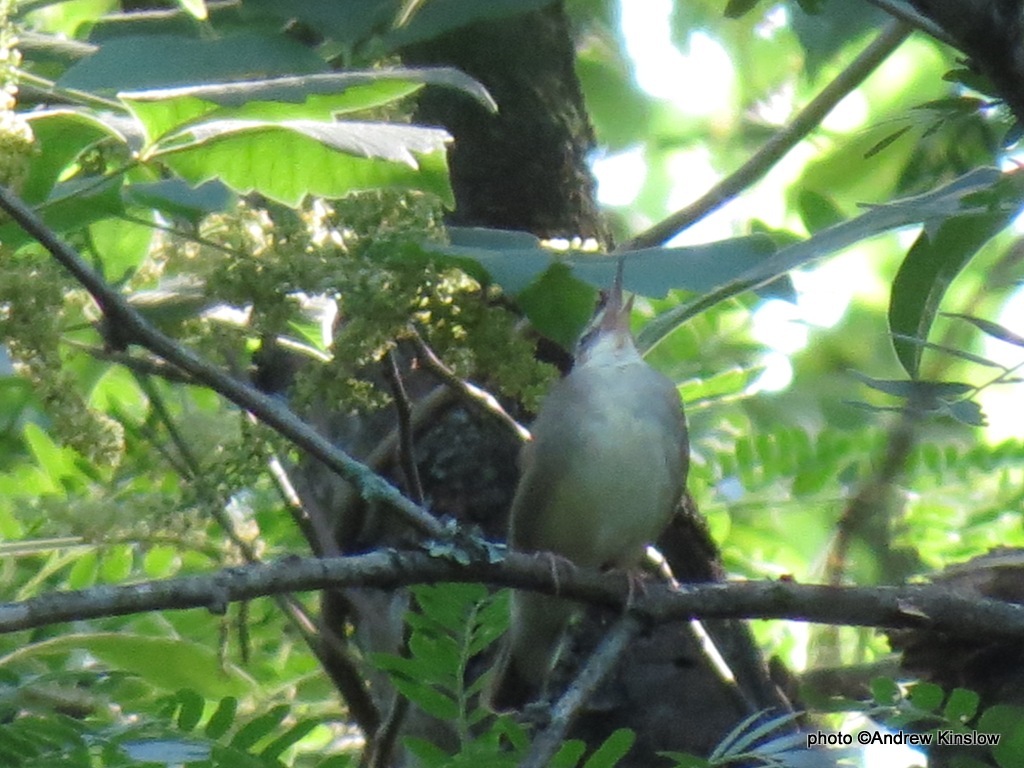
            It may sound like it, but the Swainson's Warbler was not the only bird we saw.  Here is Andrew's photo of a Hooded Warbler!
            Long before this day when I heard and then saw this life bird, the Swainson’s Warbler, I was called by its haunting melody.   For several years, I traveled to the most predictable Swainson’s Warbler location in Missouri at the Greer Access of the Eleven Point River.   More recently, I traveled to Howell Woods in North Carolina to view the bird in NC’s most reliable Swainson’s habitat.  But the student, apparently, was not ready, and the teacher…. Or bird, did not appear. 

            Four years ago, the Greater Ozarks Audubon Society developed a project to restore critical habitat for Missouri’s endangered Swainson’s Warbler.   The Green Leadership Academy for Diverse Ecosystems (GLADE), of which I am a founder and co-director, is far more than a bird camp that restores riparian cane habitat, but its roots are there in the canebrakes, which diminished in an age of reservoir creation and food plot biology in the White River Basin.  With the disappearance of the cane, so went the Swainson’s Warbler.  The last Swainson’s Warblers nesting at the Drury-Mincy Conservation Area, an Important Bird Area where GLADE is held, was over ten years ago.

            In GLADE, we are training a new generation of conservation leaders who currently work in riparian cane restoration to bring back a species few will ever see.  Even those who attend the academy have a very small probability of seeing what we saw this day.  Still, these young conservationists work tirelessly for the day when the song of the Swainson’s Warbler echoes off the limestone bluffs that rise above our Ozarks streams.    Last spring University of Missouri Bird Researcher Will Lewis heard the Swainson’s melody as it passed through the restoration area at Drury-Mincy.  It was the first sighting since the restoration work began.   

            Today our GLADE alum look to an alternative future where they bring their children or grandchildren to their restoration site at Drury-Mincy to view the little bird with a big song…..  The bird that is a worthy teacher, but only if the student is ready!

Wednesday, January 11, 2012

Buffalo Dancers, Part II

      Ok, I know that it was taken me forever to get back to blogging after my amazing experience at the Museum of the American Indian in early November, but it seems that time stood still for a while.  Only now am I getting around to the "end of the story".  Although the awards ceremony became blurred for me after I received a mentor award, there were two other incredible mentor award recipients that I managed to leave out in my previous blog entry.  My apologies to two incredible women.

       Dr. Shani Kleinhaus works tirelessly for the Santa Clara Valley Audubon Society in the Silicon Valley region of California.  A self-described Environmental Advocate,  Shani is described to a tee on the Santa Clara Valley Audubon website.  "Shani (pronounced shaa-knee) works to protect and promote wildlife habitats and to include conservation in local development plans. She represents the Chapter before local governments and supports the executive director in addressing issues of land use, wildlife and habitat, and environmental impacts.  She works closely with our Environmental Action Committee and volunteers on a plethora of conservation issues in the county. Shani earned her Ph.D. in Ecology from UC Davis and has contributed to conservation research, advocacy and planning in a variety of ecosystems in the US and overseas."  
     During her TogetherGreen year, she engaged immigrant communities in the preservation and protection of some the last remaining Burrowing Owl habitat at Mountain View's Shoreline park
     Shani became my friend and kindred spirit during our year as TogetherGreen Fellows.   Her enthusiasm for life was evident when she and I hiked down to the Potomac River to join the "young fellows" for a midnight, moonlight, around the campfire gathering during our first training session at NCTC in August of 2010.  Again we found ourselves joining the "young fellows"  while in Washington, DC for the final TG Retreat in November of 2011, where we shared a meal at an Indian restaurant and endured the noise of an Irish Pub before we and Stacy Vigallon hiked across the National Mall on a balmy autumn night.
TogetherGreen Fellows enjoying an evening in DC.  Stacy on the left.  Shani on the right.

     Dr. Robin Hadlock Seeley, Marine Biologist of the Shoals Marine Labratory, a research arm of Cornell University, works to preserve intertidal habitat in Maine by protecting rockweed beds from industrial-scale cutting. She has spent the last 10 years working with the Rockweed Coalition, sharing scientific knowledge on the impacts of rockweed cutting while also listening to local fishing communities.  Her depth of knowledge of the people, flora, and fauna of coastal Maine is second to none, and her love for this land is evident in her words, expressions, and actions.
    

A self-described country girl, Robin's humble nature and kindness give no hint to her stellar career as a marine biologist and conservation advocate out of Cornell. For more info, go to the Cornell website or the TogetherGreen site.
      So you see, it still amazes me that I have been able to spend quality time with some of the greatest conservationists and environmentalists of our times.  There are still 35 more in the Class of 2010 TogetherGreen Fellows.  They all have amazing backgrounds, stories, and passions to ensure that their presence in the world has a wonderful outcome for the quality of life for all things living and growing.  I will remember them all forever.

Sunday, November 13, 2011

Jumping Mouse and the Buffalo Dancer

It was 25 years ago when I first discovered a book that changed my perception of everything.  The book was called Seven Arrows, and it was written by Hyemeyohsts Storm.  I was going through a time in my life when I was endlessly searching for meaning, and I wandered into a bookstore, where it caught my eye.  At the time my wife and I were school teachers with two young children in the Ozarks, and I was just starting back to graduate school.  I didn't have the money to buy the book, so I headed to the campus library.  I found the book in the card catalog of the university library, but it was not on the shelves.  After searching, the librarian said that it must have been taken.

Nearly a year later, a dear friend and neighbor was dating a man who had worked in the library.  Not sure why, but he gave the book to my friend.  I marveled at its unexpected entry into my life, and my friend Cathie and I still laugh about it to this day. After perusing it in detail, I returned it to the library from which it came.

But that is not the story that I tell today. There is a allegory in the book called Jumping Mouse about a mouse that hears a roaring in its ears.  The story is really about people who are often too busy with the trappings of everyday existence to hear the song of the river, the symbol for authentic life.

And so I begin my story from earlier this week. 

I had the profound pleasure of attending the retreat for the Class of 2010 TogetherGreen Fellows.  It was held in the magnificent Smithsonian Museum of the American Indian, in the heart of Washington DC.  It was a time for closure for all 40 of us, after we had spent the past year in each other's midst.


2010 TogetherGreen Fellows and the Buffalo Dancer II.
 My fellow Fellows are among the most inspiring conservationists in the nation.  This time together allowed us to rub elbows with  many of the absolute greatest conservationists in the world: like Gerry Ellis, photographer extraordinaire, just one degree of separation from the likes of Jane Goodall, Dian Fossey, and many more.  To say it transformed my life is an understatement. 

On Wednesday morning, our last day, and before the meetings began, I took an early morning stroll in the National Mall.  It was surreal to be in this place as the slanting rays of the sun peaked over Capitol Hill and splashed across the golden landscape extending down and beyond the Washington Monument.  I was in a reflective mood, after three days of complete immersion in the sanctifying waters of this nature-inspired realm, the Museum of the American Indian and people who gathered there. 

The Buffalo Dancer II.  There a little mouse hole just under his right foot! 
Arriving at the museum with 15 minutes to spare, I soaked in the warmth of the sun while sitting on the limestone bench that meanders near the building's landscaping.  A 12 foot bronze statue of a buffalo dancer loomed above me.  It was there that my story begins.

Hearing a rustling in the plants that grace the riparian edges of the museum, I looked for a regular DC resident, perhaps a House Sparrow.  But what emerged from the vegetation was something far more curious.  It was a tiny mouse, a ground dweller, with whiskers brushing across the brush, eye glued upon its immediate surroundings.  It was unaware of my presence, or perhaps complacent within the normally human dominated surroundings.  I prefer to think "he" was there to instruct me. So, I became a watcher, frozen in time and space, as the mouse went about doing its mouse things, always close to the living earth.

I simply hung out with the mouse.  After what seemed like an eternity, he climbed upon the first ledge of the giant bronze figure and made eye contact with me for the first time.  Not overwhelmingly startled, he scurried a bit, jumping to another ledge to the base of the statue.  Then, as quickly as he appeared, he disappeared into a tiny hole at the soul of the dancer's foot.  In my mind, he transformed  into the Buffalo Dancer.  

My mind reeled over what I had just seen, going back over the many times in my life that Nature had become my facilitator, easing me through life transitions, dark abysses, and everyday joys.  And then I remembered the story of  Jumping Mouse, who had heard the roaring in his ears, and tracked it to its source. 

Fast forward a bit through a morning that featured an incredible Storytelling workshop, views of the Capitol building bathed in autumn light, a deft accipiter breaking a flock of pigeons into a burst of colorful hues.......  Fast forward through another moment of clarity as Jesus Garcia of the great Northwest (what we call the Southwest) nourished my soul with a story that tingled my olfactory and culinary senses, allowing the food history of the desert landscape to come alive.

Fast forward to a luncheon, where a beautiful collection of TogetherGreen stories, performed by my dear friends and colleagues, inspired a room full of dignitaries with their undying passion and underlying joy.

And then......  "The 2010 TogetherGreen Fellows have nominated individuals for the Mentor Award, which recognizes three people who have supported their class in a special way during their Fellows year."

Diane Husic

First, Diane Husic.....  simply amazing.....  Biochemist.  Chairman of the Department of Biological Sciences at Moravian College.  World-renowned Climate Change Expert.......  The list goes on and on, and includes...    Brilliant, kind, compassionate, outgoing, effervescent, parent extraordinaire,  writer, transcendent, the power to change the world resonating from within and overflowing into the natural landscape.....     And the FIRST Fellow with whom I crossed paths at the hotel last Sunday.  (We immediately joined forces, jumped on the Metro to the Whitehouse, and participated in the protest of the Keystone Pipeline!)

Fernando Bretos

Second, Fernando Bretos...... from the moment I met this man, I was mesmerized by his passion and ability to inspire.  An American of Cuban descent, he touched my life as he has so many before and after me with a vision of an art/nature alliance that restores the Red Mangrove forests of south Florida and engages people in community and joyous fellowship along the way.
(I drove my wife crazy when last fall we watched a Nature episode on Cuba where Fernando was featured, as I exclaimed, "I know that guy, he's really great!" about five times throughout the documentary!)   A scientist with an artistic flare, Fernando's impact extends around the globe.   Again, I think:  Brilliant, kind, compassionate, outgoing, effervescent, transcendent, the power to change the world resonating from within and overflowing into the natural landscape.

And then.... What? Greg Swick?  How did this happen? A mistake perhaps.... But then, no,  I think I "get it"  ... 

Thanks, little mouse, for providing me with a clue, for always being on the other side of my mirror, and for joining me in my journey  to discover the source of the roaring in my ears.  Thanks for pushing me to confront my fears, to plunge into the river of life, to fight against the current, and then to let go and allow its natural flow to carry me to a place of trust, passion, and peace.

Thanks for jumping, little mouse, for as we jumped together, we caught a glimpse of the sacred mountains.  And we became the Buffalo Dancer, and delighted in our dance of thanksgiving....
Grandpa Greg jumping with Noah, my inspiration!


"Standing 12 feet tall and weighing a ton, the statue showcases the spirit of the Pueblo Indians, depicting a young man offering thanks in the ceremonial buffalo dance. "Native American people pay respect to the buffalo for everything it gives them," Rivera says, "and show their gratitude in dance."*

*quoted from  http://www.historynet.com/george-rivera-art-of-the-west.htm


Friday, November 11, 2011

Dancing to the Beat of Life

I dedicate this blog post to my dear family of 2010 TogetherGreen Fellows.  You have allowed me to explore my own vision for the past year.  I am eternally grateful to every one of you, and am humbled to have received the Mentor Award from you.


"A man who has a vision is not able to use the power of it

until after he has performed the vision on earth for the people to see" ~Black Elk

     It is easy to view the world as it is, and hide behind a cloak of cynicism. There is always the quick wit of a sarcastic barb to ease the pain that inconveniently surfaces from within. It is not so easy to acknowledge that beneath one's cynicism lies an idealist who sees the world not as it is, but as it should be.

     We who strive for ecological wellness and social justice experience and too often shed tears for the losses in our efforts to ease the pain present in our world. Nevertheless, we passionately work to restore, heal, and create a new world where justice prevails, green space flourishes, and sustainability reigns for all of posterity.

If anyone tells us that the way is impossible, it will fall upon deaf ears, for we have gazed into the heart of the Earth, and have "heard" its ancient cry. It defines who we are, and it imparts meaning to our existence.

     I come to the end of this TogetherGreen Fellows adventure with an unwavering sense of gratitude and a renewed commitment to doing whatever I can in the time that I am given to ride this passionate wave of synergy aimed at reversing the destructive path that our species has chosen. I join with many other kindred spirits to explore beyond the horizons, to open reluctant minds, to empower the curious, to enliven the senses, and to instill an understanding that the answers to our quest lie in the heart of nature, where they have been nurtured, preserved, adapted, and refined through the spacious eons of time.
     May we all experience our personal revelations in the natural rhythms, melodic expressions, and harmonic overtones of nature.  May we further allow them to resonate deeply within our own hearts and radiate outward to all things living and growing. Perhaps then, our species can rejoin a multitude of other precious species that have not forgotten how to dance to the beat of life.
"Those who contemplate the beauty of the earth find reserves of strength that will endure as long as life lasts" ~Rachel Carson.

TG photo by Gerry Ellis, copied from Facebook
Heart of Nature photo by Jessica Eggleston, GLADE 2011

Tuesday, October 11, 2011

Show Me Oz Link

Read a compilation of my recent blog posts over at Jill Henderson's blog Show Me Oz: The Very Best of the Ozarks.

Sunday, October 9, 2011

Aiming to Transform

"People say that what we‟re all seeking is a meaning for life. I don‟t think that‟s what we‟re really seeking. I think that what we‟re seeking is an experience of being alive, so that our life experiences on the purely physical plane will have resonances within our own innermost being and reality, so that we actually feel the rapture of being alive."  ~Joseph Campbell, The Power of Myth)


Many times prior to and during the writing of Gold in the Glades, the word transformation has been used to describe the experiences of the youth. It is not a word to be taken lightly nor is it to describe a normal enjoyable outdoor experience. Rather, it is reserved to express the idea that something very significant has occurred in the lives of the participants. To dispel notions of hyperbolae, it is necessary to explain why the word is appropriate to describe the effects of the GLADE experience on its participants.

Throughout human history, cultures have used rites of passage to signify the importance of life transitions. Our own society still recognizes and celebrates transitions with weddings, baby showers, anniversaries, and funerals, but little is communicated about the role of these events in the human maturation process.


Transformation used in the positive sense implies that the perceptions of an individual have been altered to give him/her more clarity and purpose in life. As a result of the GLADE experience, the participant's world is perceived differently, with greater appreciation and gratitude for nature and everything else that is good. This nature-impacted perception of reality is incorporated into the very fabric of the youth, and all is renewed. If credibility can be assigned to student reflections long after the academy week has passed, the term transformation can be applied to the GLADE experience without hesitation.

Analysis of life experiences can help us to define the human experience and to appreciate the profundity of our existence. Unfortunately for teens,there are few effective educational models that address life phases and smooth out the tranisition from dependent adolescence and responsible adulthood.  Effectively meeting the challenge of  this oversight in education can serve to expedite the process of finding direction and meaning in one's life.

Graduation exercises have become extremely frivolous, and participants rarely use this transitional period to reflect upon their existence or life purpose. The result is that the time between the adolescent condition and the adult condition has been extended in modern American society, with remnants of adolescence being expressed in individuals well into their thirties and beyond.

GLADE incorporates activities that can serve as a catalyst to promote a type of reflective reasoning that facilitates personal growth and development. These activities recognize that three conditions are necessary for personal transformation. These three conditions can be briefly described as the departure, the experience, and the reentry.

The first condition of departure indicates that elements of everyday life, formerly perceived as essential to the adolescents, are left behind. Many of our students leave their parents, homes, siblings, friends, and other valuable elements of their identity for the very first time in their lives in order to participate in the week-long, residential project. There is a going away, that elicits a sense of loneliness, soon to be replaced by a sense of independence in the second phase of transformation.

The second phase of the GLADE experience is full of new and exciting adventures that fill the mind and touch the heart. New friendships are established with kindred spirits that share a love for the outdoors and fill the void created upon their departure from family and friends earlier in the week. The tools of personal change are the tools of the research scientist and the conservationist: mist nets, dip nets, testing kits, shovels, handsaws, pencils, clipboards, writing and sketch pads, and much more. The doors to this natural realm are many. The keys to entry are the sciences, the arts, the humanities, the engaged mind, and the open heart. The immersive experience provides the youth with a new way of perceiving. Nature is a life instructor to those who enter its domain and experience its treasures.

The third and most difficult condition of the transformation is reentry. Again, the overwhelming feelings of loss and departure loom on the horizon as the week draws to a close. How can one adequately explain with words what has happened upon his/her return to everyday life in his/her home community?

“I wish I had a camera as good as my eyes,” Jessica B., GLADE 2011, reflected. If only there was a snapshot that could express the passion of these young leaders as they experience together the sun setting over the lake.


Then perhaps their loved ones at home could understand their transformation and share their newfound passion.


Post-GLADE reunions, community grant projects, and public presentations provide an opportunity for the newly emerged green team to reignite the flame experienced during the week of the academy. If the staff and community have done their job well, GLADE graduates have been welcomed into a growing network of people and organizations who share a love for nature and a desire to positively impact the natural world through conservation action. The GLADE network has provided them with immediate access to the expertise and resources necessary to translate their inner desires to change the world into local action to shape their home communities in remarkable ways. They reenter with knowledge, wisdom, and human connections that not only ease their transition, but catapult them into a bright future with a metaphorical green tool kit designed to give wings to their greatest visions for a dynamic, living planet.

The universal human conditions of departure, experience, and reentry provide the backdrop for the GLADE project. Our goals within that context are to increase the young leaders‟ knowledge and awareness of biological systems, to provide experiences that facilitate personal growth and development, and to connect each individual to a growing network of people who recognize that our own fate is directly related to the fate of the other species that share the Earth with us. With nature as our common passion, we aim to revitalize and to transform young peoples‟ lives so that our precious natural resources are passed on to their children‟s children.

Wednesday, October 5, 2011

Be Here Now

     Yesterday, I took my book, Gold in the Glades: The GLADE Guide to Outdoor Leadership Development, to the printer. It is a milepost for me, the culminating event in a year long journey to document everything that I could about the GLADE project and experience. It was a soul searching process. Some days the words just wouldn't come, clogged in some muddy ooze, unable to free themselves. On other days I couldn't stop them from flowing, like a effervescent spring in the heart of the Current River watershed.

“A man who has a vision is not able to use the power of it until after he has performed
 the vision on earth for the people to see." Black Elk.

     My personal vision of conservation has been with me for a long time. Its expressions took the form of experiential courses and projects for secondary students. Environmental Awareness and Group Leadership Explorations (EAGLE) 1986-2000, explored the role of nature in risk taking and personal growth in a natural setting. Analysis of Environmental Relationships in Individual Expression (AERIE), 1994-1998, explored the role of nature in inspiring creativity, and Green Leadership Academy for Diverse Ecosystems (GLADE), 2009-present, explores nature through ecological relationships, critical habitat restoration, community service, collective vision, and the nature of leadership. They are all courses that I developed alone or helped to develop. I have been a lead teacher in all of them. And, they all express my personal vision of conservation. Way too simple, it boils down to 10 words: "Be passionate. Be grateful. Be hopeful. Give back to nature."

It has worked for me. I share my  thoughts from the book below.


     It is easy to view the world as it is, and hide behind a cloak of cynicism. There is always the quick wit of a sarcastic barb to ease the pain that inconveniently surfaces from within. It is not so easy to acknowledge that beneath one’s cynicism lays an idealist who sees the world not as it is, but as it should be.

     We who strive for ecological balance and social justice experience and occasionally mourn the losses in our efforts to ease the pain present in our world. Nevertheless, we passionately work to restore, heal, and create a new world where justice prevails, green space flourishes, and sustainability reigns for all of posterity. It does not help to tell us that the way is impossible, for we have gazed into the heart of the Earth, and have heard its ancient cry. It defines who we are, and it imparts meaning to our existence.

      I come to the end of this TogetherGreen Fellows adventure with an unwavering sense of gratitude and a renewed commitment to doing whatever I can in the time that I am given to ride a wave of passionate energy to reverse the destructive path that our species has chosen. I join with many other kindred spirits to explore beyond the horizons, to open reluctant minds, to empower the curious, to enliven the senses, and to instill an understanding that the answers to our quest lie in the heart of nature, where they have been nurtured, preserved, adapted, and refined through the spacious eons of time. May we all recognize these natural rhythms and allow them to resonate within our own hearts. Perhaps then, our species can rejoin a multitude of other precious species that have not forgotten how to dance to the beat of life.

“Those who contemplate the beauty of the earth find reserves of strength
that will endure as long as life lasts. ~Rachel Carson

Tuesday, September 6, 2011

A Bird in the Hand.....


“Hope is the thing with feathers” ~Emily Dickinson

The Green Leadership Academy for Diverse Ecosystems (GLADE) activity of mist netting and bird banding illustrates beautifully the moment when students truly engage in and connect with nature. In the cognitive domain, it enables students to fully participate in important scientific research. In the affective domain, it allows the students to observe the traits of the neotropical migrant, and incorporate them into one’s own fabric. Both actions serve to unearth a sense of potential within that is vital to becoming an effective leader.

The bird banding activity is part of a larger scientific research project of the Institute for Bird Populations. The specific outreach project of the institute is called the Monitoring Avian Productivity and Survivorship (MAPS) Program. According to its website at www.birdpop.org/maps.htm, MAPS “comprises a continent-wide network of hundreds of constant-effort mist netting stations. Analyses of the resulting banding data provide critical information relating to the ecology, conservation, and management of North American landbird populations, and the factors responsible for changes in their populations.” GLADE staff members Dr. Janice Greene and Andrew Kinslow participate annually in the census project.

The MAPS project provides an opportunity to impact humans as well as birds. The convergence of life paths between these nearly weightless, beautiful, long-distance sojourners and the GLADE naturalists brings knowledge of and appreciation for the survival strategies of the neotropical migrants. The migratory routes of these birds also connect two worlds for the youth. Our own Ozarks habitats and Central and South American habitats, where nesting migratory species of the Ozarks spend much of their lives, are suddenly linked in the minds of the young people. The bird banding activity literally and figuratively expands horizons, and increases global ecological awareness. It provides a key to unlocking an overwhelming appreciation for all life and an opportunity to think about the possibilities of conservation partnerships across the entire geographic range of these fascinating avian travelers.

During the morning activity, resident and neotropical species are netted, bagged and taken to an open-air banding table, where students engage in ornithological pursuits---measuring, aging, sexing, weighing, and banding cause the time to stand still. Students embrace the experience with the resident and neotropical species. In doing so, they develop a new perspective on birds. A sense of calm becomes palpable within the group of young naturalists. Countenances reveal an inner change taking place.

They say that a picture says a thousand words. If so, the photographs of Kelsey Rumley, GLADE 2010, spin a heartwarming tale.


Taylor gazes at an Indigo Bunting while Martha observes.

Introspective onlookers watch Heather, as Baillie delights in an Indigo Bunting.


A brightly colored male Summer Tanager puts a glow on Jessi’s face.

Jessi appreciates the contrasting Black-and-white Warbler.

Bryanna studies the Brown Thrasher in depth.
Tim enjoys the beauty of the Summer Tanager.

Sunday, September 4, 2011

Passion: The Sublime Elixir


“Most men lead lives of quiet desperation and go to the grave with the song still in them.”

~Henry David Thoreau

When Green Leadership Academy for Diverse Ecosystems (GLADE) graduates express their experience in one final word, or when they write their comments on post academy surveys, the word “passion” never fails to make the collective list. It is noted that GLADE staff and presenters often are animated and extremely enthusiastic about what they are doing. It is true that our staff clearly has an affinity for nature, and that it has impacted their individual lives in profound ways. Actually, we naturally select for passion traits in staff, in presenters, and even in our GLADE participants.

Passion sublimes in far more than a smile and accompanying gestures of excitement. When released in the proper, timely manner in nature, it lingers in the air like a splendid perfume, luring those even at the very outskirts of its aesthetic range. It leaves an indelible mark on the lives of those who risk breathing it in deeply and incorporating its essence into their own being. Passion connects those experiencing it with all things living and growing, communicating meaning and purpose to everyday experiences.

As committed agents of positive change, we long to reproduce the elixir. But what is it, and once found, how do we cultivate it? From where does it arise within the group setting, and how can conservation educators assure that it can be replicated in all outdoor learning experiences?

The conditions which precede knowledge of self are intellectual curiosity and emotional uncertainty. As youth search for direction they often head down paths that tragically result in dead ends due to our society’s emphasis on temporary and material gain, and its wanton disregard for virtue. Families, schools, and faith communities strive to provide youth with effective examples of proper living, but rarely do they espouse proper stewardship for nature or take action to care for biotic communities. The lure of a material world permeates society to the point that well-meaning adults working with young people too often advise them to take a path that will result in a lucrative material career, ignoring the leanings of the heart, which nearly always navigate in a truer direction.

Our guidance systems are flawed partially because they do not acknowledge the role of nature in our wellbeing, and they do not consider the negative impact of today’s squandering habits on future generations. When all is said and done, our grandchildren’s quality of life is directly proportional to the quality of our care for the Earth today. If for no other reason, we owe it to them to passionately act in every way we possibly can to conserve what is left of our natural world.

At the convergence of intellectual stimulation and emotion gratitude lies passion. It does not make itself known until the intellect has been challenged at the limits of its capacity, and the emotions have responded to the power of the mind to discover new and different ways of perceiving. Often, prior to the passion experience, true awareness of entities like nature and life have been obscured by a cloudy vision and/or self-imposed limitations. Passion demands that we find the sweet spot in the ocean of life, where our intellect is fully engaged and our emotional gratitude intersects with it. The outcome is a tremendous wave of positive energy. We must rise to the crest of that wave, be swept away by it, sense its power, balance upon its lip, and ride it with all the energy we can muster. For when the wave breaks upon the shoreline, all is changed. Hope is renewed, new possibilities surface, and a desire to catch the next wave rises up from within to become an overwhelming goal for our lives.

As demonstrated in the above paragraph, natural metaphors can play a very important role in the transfer of information, as well as in the youth transformation aspect at GLADE. It is always the aim of the staff to sense the building momentum spontaneously and use metaphor to transport creative and critical thinking to a higher level. Seizing that moment and riding the wave that underlies it is often the key to a truly exceptional environmental experience.

Metaphorical quotes and comments incorporating ecology and philosophy serve to facilitate personal growth and development within the participants at a moment’s notice. Native American teachings, Taoist passages, the writings of the Transcendentalists, and other nature-inspired writings are excellent sources from which to draw. Quotes and readings memorized and used by staffers at appropriate moments provide fertile soil for the stirring of the passion waters within the young naturalists, and they contribute significantly to the synergy desired.

Even with the use of simple natural metaphors such as “sink your roots deeply” or “soar”, a life tool is introduced to the young people that can assist them in fully comprehending many of the complexities inherent both in natural biological systems and in their own personal lives. The insights gained from natural metaphor then can be fused into their developing value systems, giving them strength, insight, character, courage, and an incredibly respectful view of nature as teacher. Metaphor serves to forever link the individual to the natural world and opens a new world of possibilities within the engaged mind. To connect the natural sciences to the arts or the humanities - to the stillness of sunsets or the sparkling of fireflies-- or to the inner soul or spirit of the individual, brings wellness to the explorer. At the end of the GLADE adventure, passion is waiting to wash gently over the receptive youth.

Passion does not seek to change the individual, but to complete the individual. In lives once dominated by the trappings of a shallow world, the passion that arises from complete immersion in nature mirrors the first blossoms of spring poking through a blanket of snow. As a result, the joy, the hope, and the unbridled sense of empowerment that emanates from within effortlessly unearths the individual’s missing piece….releasing their unique, hidden song from within…..., bringing clarity of vision and purpose to life.